
Are you interested in becoming a U.S. Foreign Service Officer (FSO)/diplomat in 2026? Then this is the guide for you!
Along with a discussion of the process for becoming an FSO/diplomat, I will also share steps you can take to best prepare for the application, the Foreign Service Officer Test (FSOT), and the officer assessment.
So, if you want to join the Foreign Service and represent your country as a diplomat, then you’ll love this updated guide.
Table of Contents
Foreign Service Officers
What does a Foreign Service Officer/diplomat do?
Diplomats are the official representatives of the United States government overseas. These public servants are on the front lines of building peace, improving trade relations, and protecting U.S. citizens abroad.
The official mission of the Foreign Service is “to promote peace, support prosperity, and protect American citizens while advancing the interests of the U.S. abroad.”
With more than 270 diplomatic missions worldwide, you can represent your country globally, learn new languages, and interact with people and cultures that differ from yours.
What are the Foreign Service Officer career tracks?
- Consular
- Economic
- Management
- Political
- Public Diplomacy
Consular Officer
For many U.S. citizens in overseas countries, the Foreign Service Consular Officer is the principal diplomat they will (ever) interact with while abroad. Adjudicators of visas and the primary support to U.S. citizens abroad, the Consular Officer must hold a broad range of skills. Unlike the other career tracks, acting as a Consular Officer for your first or two tours is a “rite of passage” for most entry-level officers. Learn more.
Economic Officer
Management Officer
The ones who keep the embassy or consulate running, the Foreign Service Management Officers are in charge of small and large projects. They receive training to manage real estate, human resources, logistics, construction, budgeting, and more. Staff leaders, management officers supervise (potentially several) local staff from the beginning. Learn more. Learn more.
Political Officer
The Political Officer’s role is to be in the know to provide advice. When you think of the Foreign Service, the political officer’s duties are the ones that come to mind the most for people. These duties include: keeping up with national and international trends that affect the host country, speaking and networking with government officials and subject matter experts on a topic, and writing numerous reports. Learn more.
Public Diplomacy Officer
The cultural bridge between the U.S.mission and the host country, the Public Diplomacy Foreign Officer, is the gatekeeper and promoter of information concerning the United States. During your career, you may represent a post as the spokesperson, promote student and professional development exchange via the Fulbright Program, organize discussion groups with the local community to teach, or be a resource on U.S. culture. All in all, increasing the influence of the U.S. via “soft power.” Learn more.
How do you become a Foreign Service Officer/diplomat?
There are several ways to become a Foreign Service Officer/diplomat. Different routes include transitioning from the Civil Service to the Foreign Service via the Mustang Program or joining the career through the Pickering Fellowship or other similar paths. However, the most common approach for applicants is to complete the Foreign Service Officer selection process.
The FSO selection process is a “marathon, not a sprint” that nearly 15,000-20,000 aspiring FSOs attempt each year (pre-2025) for only a handful of open slots.

There will be moments during the selection process that require your full attention and other times when you won’t do anything for weeks or months. A safe bet is to consider the whole process, from your decision to apply to day one on the job, to take an average of 1.5 years.
What do you do during this time? The FSO selection process consists of the following:
- Application
- Foreign Service Officer Test (FSOT)
- Officer Assessment
- Security and health clearances
- Final suitability review panel
- Register
At almost every point listed above, there is the possibility of not moving forward to the next round.
The Foreign Service Officer application
Who is eligible to become an FSO/diplomat?
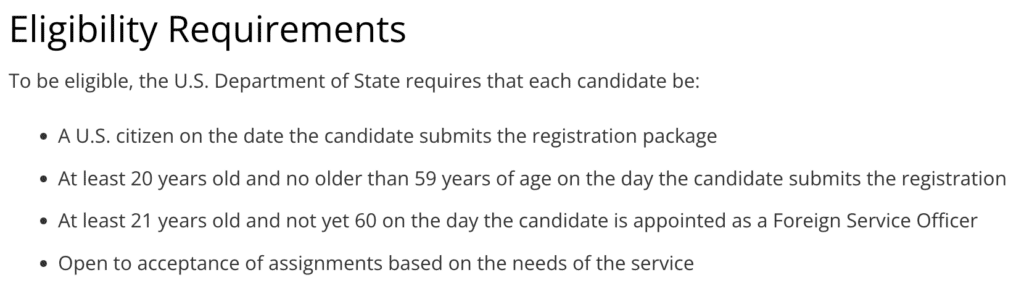
To be eligible, the U.S. Department of State requires that each candidate be:
- A U.S. citizen on the date the candidate submits the registration package
- At least 20 years old and no older than 59 years of age on the day the candidate submits the registration
- At least 21 years old and not yet 60 on the day the candidate is appointed as a Foreign Service Officer
- Open to acceptance of assignments based on the needs of the service
When can I register for the FSOT?
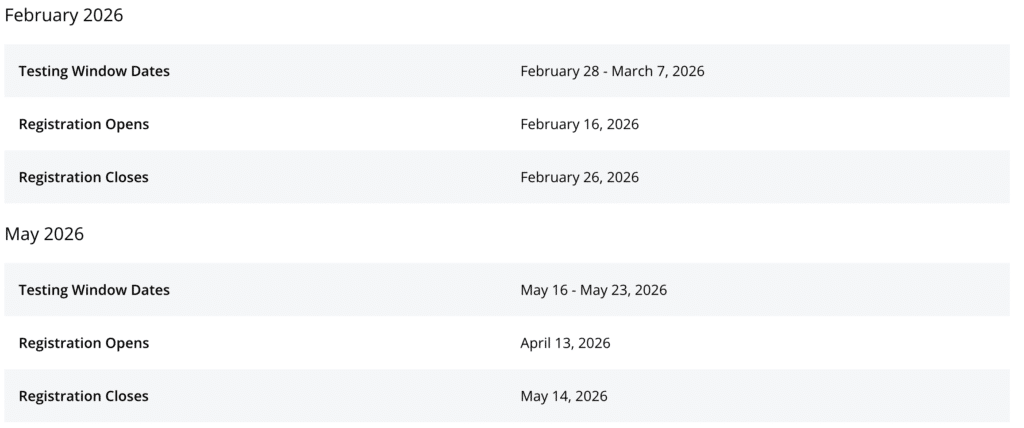
The FSOT is offered three times a year, and each testing window has its own registration window, which opens about five weeks before the testing window. The FSOT is traditionally offered in February, June, and October.
The testing windows for 2026 are:
- February 28 – March 7
- May 16 – 23
- October TBD
To register for the FSOT, visit the Pearson VUE portal.
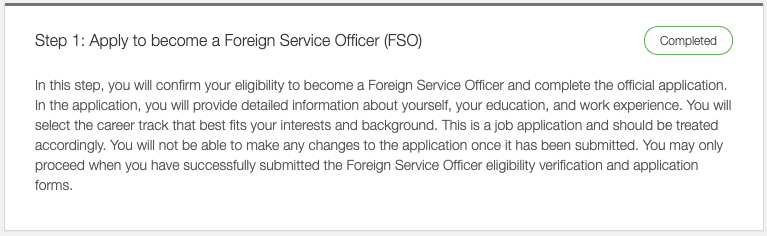
The FSO Application
The application is an important yet overlooked part of the FSO selection process.
The application is the first opportunity the Board of Examiners (BEX) has to learn who you are.
Many candidates treat the application as a resume formality and overlook that it is a crucial opportunity to explain to BEX why they are qualified for their chosen career track.
The main sections of the application are:
- About you
- Military service
- Career track
- Education
- Language proficiency
- Work experience
- Other personal information
If applicable, you are responsible for interweaving what you know about the career track in the application.
Select your FSOT seat
Once you submit your application, it’s time to select your date and seat.
Note that selection is first-come, first-served! It is advantageous to submit your application as soon as possible.
Applications are only valid for the period you are planning to test, and the registration period closes three days before the opening of the examination window. Candidates may test only once in 11 months.
Candidates may test online or at a Pearson testing center. If you plan to take the test in person, determine in advance where it may be offered. This link includes overseas testing centers for those who require them, but note that they are limited and generally located in the capital.
A special note for overseas test takers: if you know 2-3 months before the test date that you will take the test, check with the testing location to ensure they are registered to offer the test. If they don’t register or forget, you will have to wait until the next testing window.
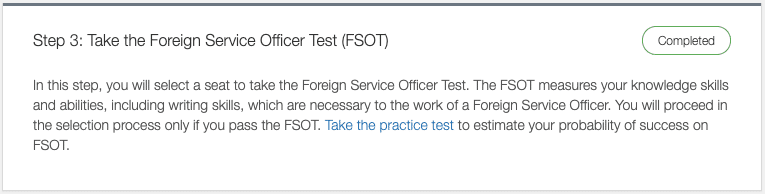
The Foreign Service Officer Test (FSOT)
The Foreign Service Officer Test is a significant hurdle most applicants associate with becoming an Officer. This historical association stems from the fact that upwards of 60% of applicants did not pass the test in each round (pre-2025 statistic).
The test consists of the following three sections:
- Job Knowledge
- English Expression
- Logical Reasoning
All sections are multiple-choice, completed on a computer, and are timed.
Job Knowledge
The job knowledge section is about breadth, not depth. State expects you to be familiar with several different knowledge areas. As the State Department puts it:
The FSOT assesses knowledge and skills that the candidate has acquired from reading widely from many different sources, study or course work in several related fields, and other career or life experiences.
On test day, you have 40 minutes to answer 60 questions.
The job knowledge areas follow:
United States Government
This knowledge area encompasses a general understanding of the composition and functioning of the federal government, the Constitution and its history, the structure of Congress and its role in foreign affairs, as well as the United States political system and its role in government structure, policy formulation, and foreign affairs.
United States History, Society, Customs, and Culture
This knowledge area encompasses an understanding of major events, institutions, and movements in national history, including political and economic history, as well as national customs and culture, social issues and trends, and the influence of U.S. society and culture on foreign policy and foreign affairs.
World History and Geography
This knowledge area encompasses a general understanding of significant world historical events, issues, and developments, including their impact on U.S. foreign policy, as well as knowledge of world geography and its relationship to U.S. foreign policy.
Economics
This knowledge area encompasses basic economic principles, as well as a general understanding of economic issues and the United States’ economic system.
Mathematics and Statistics
This knowledge area encompasses a general understanding of basic applied mathematical and statistical procedures. Items requiring calculations may be included.
The best approach to prepare for the job knowledge section is to read and take practice tests.
This is in addition to reading a regular periodical, such as the New York Times, Washington Post, or The Economist (the latter being my recommendation).
Now, do you have to read EVERYTHING on the State Department list?
Absolutely not.
I recommend taking online practice tests to determine the job knowledge areas you need improvement in and then focusing your studies/reading on those areas.
You can find online timed practice tests on FSO Compass and the State Department.
English Expression
The English Expression section of the FSOT will remind you of the English portion of the SAT or GRE.
The questions in this section concern mini-essays and sentences that may have grammatical errors. Also, different prompts will ask you to garner the passage’s meaning.
To pass this section of the test, you must understand the following:
Correct grammar, organization, writing strategy, sentence structure, and punctuation required for writing or editing reports: This knowledge area encompasses English expression and language usage skills needed to prepare or edit written reports, including correct grammar and effective sentence and paragraph structure.
You will have 50 minutes to complete 65 questions.
Logical Reasoning
The Logical Reasoning section is new to the FSOT as of October 2025. Unlike Job Knowledge or English Usage and Comprehension — both of which existed in previous versions of the test — this section is entirely new. It was introduced as part of the broader FSOT overhaul announced by the State Department in September 2025.
The Logical Reasoning section “assesses making inferences, justifying conclusions, finding logical flaws, and identifying assumptions.” In short, it measures your ability to read a short argument and evaluate whether the conclusion actually follows from what’s stated.
Each of the four components targets a specific dimension of reasoning:
- Making inferences: Drawing conclusions from given facts or statements — even when those conclusions aren’t explicitly stated.
- Justifying conclusions: Identifying which evidence supports or undermines a claim.
- Finding logical flaws: Spotting reasoning errors such as circular reasoning, false causation, or irrelevant evidence.
- Identifying assumptions: Recognizing the unstated premises an argument depends on to hold together.
Through this section, State is attempting to assess whether you can parse complex information, identify what is and isn’t reliable, and make sound judgments in uncertain circumstances.
Most questions follow a few repeatable patterns:
- Identify the conclusion (what the author is trying to prove)
- Spot the support (what evidence they’re using)
- Find the assumption (what must be true for the argument to hold)
- Strengthen or weaken (what would most help or hurt the reasoning)
- Draw a valid inference (what must be true based only on the facts given)
A critical ground rule: don’t add facts. Your job is to work only with what’s on the page — not what you think is probably true, or what you know from outside experience.
For a deeper dive on preparation strategies, read: How to Study for the FSOT – Logical Reasoning.
FSOT Scoring
In the past, to pass the FSOT, you had to score at least 154 on the test.
Beginning with the June 2022 test, candidates no longer needed to meet a minimum score.
However, as of 2025, candidates must now score as high as possible on the test to move forward. Read more about the change.
As this is a recent change, we are still determining how this will impact candidacies. Unfortunately, State is not sharing your score after you complete the test.
Qualifications Evaluation Panel (QEP)
Although the QEP is no longer officially referenced, some form of review process between the FSOT and the FSOA almost certainly remains. This section is preserved as useful historical context for understanding how that review has worked.
The Qualifications Evaluation Panel (QEP) is the first opportunity for the BEX to review your candidacy.
Under consideration are your application and your FSOT score.
Those with a high score receive an invitation to the Officer Assessment. The dividing line between being asked and not is a secret and changes with each testing cycle.
The QEP is the most disheartening stage for those who receive a denial letter, as they receive no feedback or scores to help them understand why they do not move forward.
Just remember that the journey to becoming an FSO is a marathon and not a race. Many current FSOs had to go through the process multiple times before passing. Try again next year.
What is the Foreign Service Officer Assessment?
If you receive an invitation to the Officer Assessment, then congratulations! This invitation is a massive success on its own. You are part of a small percentage of applicants who get to this round.
So, what takes place at the Officer Assessment? A bunch!
On two separate days – and weeks apart – you will complete three assessments: group exercise, structured interview, and the written exercise. You will complete these assessments via a virtual platform.
The Group Exercise
Candidates are grouped into three to six individuals to form an Embassy task force charged with allocating resources among competing projects in their host country.

After a 30-minute preparation period, during which each candidate reviews their project in silence, four BEX assessors enter the room. The lead assessor briefs the candidates and notifies them that they have six minutes to present their project. Time may be left at the end of each presentation for questions from other candidates.
Once the presentations are complete, the lead assessor will provide further instructions to the candidates. In this 20-25 minute phase, candidates have two goals.
One is to advocate for the project they were given. The second goal is to help the group reach consensus within the allotted time on which project(s) or parts of projects to recommend to the Ambassador.
It is acceptable to abandon your project in favor of another candidate’s plan after the group has thoroughly reviewed the merits and drawbacks of all projects.
Remember, the objective is to help the Ambassador decide how best to allocate limited U.S. Government resources among several worthy projects. Not to make sure your project “wins.”
Once the group has decided, each candidate will have three to four minutes privately to brief two assessors on the results of the group’s deliberations. One of these assessors will serve as the Ambassador and ask the candidate several follow-up questions. In contrast, the second assessor will escort the candidate from the group exercise room to the interview.
The Structured Interview
The Structured Interview is the closest to a “job interview” you will receive at the Officer Assessment. There are three parts to the structured interview.

Experience and Motivation Interview
This portion is the “why” for joining and the skills you will bring to the job. Don’t just describe your experience; tell them what you learned.
Hypothetical Scenarios
You are presented with several scenarios by the assessors that closely relate to real-life situations regularly encountered by Foreign Service Officers overseas. Candidates are asked to fashion a solution that employs good judgment and common sense.
You do not have to know how an Embassy operates.
Similar to the situational judgment section of the FSOT, the assessors are looking for explicit action that you will take. Do not assign your duties to others.
Past Behavior Interview
In the final portion of the Structured Interview, the BEX will ask you questions to extract your experiences in specific areas.
A question sheet is provided to you containing the dimensions under assessment, with two questions listed under each aspect.
You will have five minutes to select the questions you wish to discuss for each dimension (one item for each aspect) and to prepare your responses.
Your examples should be detailed and drawn from your own experience.
As with all aspects of the application process, ensure you answer the question. Do not try to fit predetermined talking points into what they are asking if it does not directly answer the question. You will not do well.
Written Exercise
The Written Exercise assesses if you can write an argument to a prompt within 45 minutes.
The Written Exercise changed in 2026 and is similar to the FSOT essay, as it was administered before 2025.

Scoring the Officer Assessment
The minimum Officer Assessment score to continue a candidacy is 5.25 out of a possible 7. The Group Exercise, Structured Interview, and Written Exercise each count for one-third of the total score. Overall scoring is on a scale from 1 to 7, with 1 representing poor performance and 7 representing outstanding performance.
The Register
If you pass the Officer Assessment, then the biggest of congratulations! That is quite the achievement. However, passing the Officer Assessment is not an automatic invitation to the Foreign Service.
If you score at least a 5.25, you must still pass security and medical clearances before undergoing a final suitability review. For the latter, they are looking at your history to make sure there is nothing that pops up that is a red flag for employment or an aspect of your life that foreign agents may use to blackmail or bribe you.
You are placed on the Register if you pass all of the above.

The Register is rank-ordered by your chosen career track. Your score is from the Officer Assessment, plus any additional credit for language ability or veterans’ preference.
Placement on the Register does not guarantee employment.
A dynamic list, you are not chosen based on the length of time on the Register, but instead, you are selected based on your score and the needs of the State Department. A candidate may stay on the Register for a maximum of 18 months. If no appointment is offered and accepted within that period, you time out.
In short, the higher your score, the more likely you are to receive an invitation for employment.
I hope everybody reading this gets on the Register and is invited to join the Foreign Service. As you can see, it’s quite an extensive process!
Resources to help you become a Foreign Service Officer
We all study and practice for tests and assessments in our own way. But we also like it when there are tools we can use to help us succeed.
And for the FSO selection process, there most certainly are!
Here are a few resources that can help you with the selection process:
FSO Compass
FSO Compass is your one-stop membership resource with:
- Study material and courses to help you prepare for the FSOT,
- Practice tests
- A weekly challenge,
- A monthly live Q/A call with members,
- Interviews with current and former FSOs,
- and many more resources.
State Department Practice Test
The State Department Practice Test is a great way to practice the three multiple-choice sections of the FSOT.
State Department Suggested FSOT Reading List
The State Department used to provide an extensive list of suggested reading material for aspiring Foreign Service Officers. The suggested FSOT reading list is broken up by area of study. The assortment is quite varied and worth a look.
Reddit group
Started by a few Foreign Service Officers, the Reddit group is a great resource. It’s also a treasure trove of information if you search the archive.
Facebook Group
The Facebook group (Future U.S. Foreign Service Officers) is another excellent online community. Members support each other and prepare for the assessments.
Archive of the Yahoo Group files
The Foreign Service Yahoo Group was the gold standard for studying for the Foreign Service assessments. With Yahoo’s decision to no longer support groups, this community has dispersed to other social networking sites (listed above). However, I saved the files, and with some digging, you can find fantastic items to help you prepare for the test and the Officer Assessment.
Grammarly
I’ve mentioned this tool a few times above, but it is really that good. An online tool to help you improve your writing, spell check, check for plagiarism, and much more. Grammarly has a free version that is good and a premium version that takes the cake.