
The Foreign Service Officer’s salary is dynamic and ever-changing. Along with your promotion, each assignment can bring different danger pay, hardship pay, and cost-of-living adjustments that affect what you take home.
Depending on international geopolitics, the strength of domestic and national currencies, and the size of your family, among other factors, your salary can rise or fall between posts.
With this resource and interactive maps, this FSO Salary Guide is a comprehensive introduction to how your income is determined and the three primary modifiers that affect it between posts.
Updated: March 2, 2026
It’s been three years since the last update, and a lot changed! I hope you find this information helpful. As before, feel free to access the salary calculator, which you will find a link (button) below.
FSO Salary Ladder
Every organization has a system in place to track seniority. The Foreign Service is no different.
To understand this guide, you must first learn the foundation before adding layers. Let’s dive in.
You are a brand-new Foreign Service Officer. After over a year of going through the application process (test, essays, orals, clearances, and the Register), you finally received an offer to join the State Department.
Congratulations!
Among the many thoughts running through your mind, you may begin to think about salary. Just how much will I make?
The Foreign Service allocates salaries based on a ‘ladder’ system of grades and steps.
As an incoming entry-level FSO, you are eligible for one of three grades
- FP-4
- FP-5
- FP-6
FP-4 is the highest (most senior) of the three grades.
Within each grade, there are 14 steps. Step 1 is the lowest step of each grade, and step 14 is the highest.
In short, the lower the grade number, the more senior you are. The higher the step number, the more senior you are within that grade. Your salary follows this progression: within a grade, the higher the step, the higher your pay.
In table form, it looks like this:
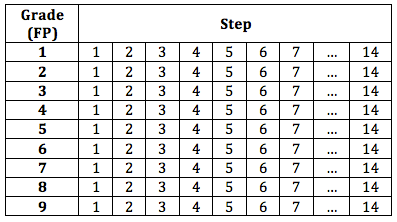
As your Foreign Service career progresses, your promotions will follow “up” this ladder.
Takeaway 1: FP-4 is the highest of the three entry-level FSO grades (4, 5, or 6).
Takeaway 2: Within each grade, there are 14 steps. Step 1 is the lowest step of each grade, and step 14 is the highest – the higher the step, the more senior within that grade.
Determining FSO entry grade and step
Now that you understand the basics, let’s determine the grade and step you could enter as a brand-new Foreign Service Officer.
This is the most significant chapter, so pay close attention!
The Department of State’s Bureau of Human Resources determines entry-level FSO grades and steps in two parts: the level of education attained and your qualifying experience.
Education and "Qualifying Experience"
First, we need to determine your level of education and the number of full years of Qualifying Professional Experience (QPE) you have attained. The image below shows how different combinations affect your grade and step.
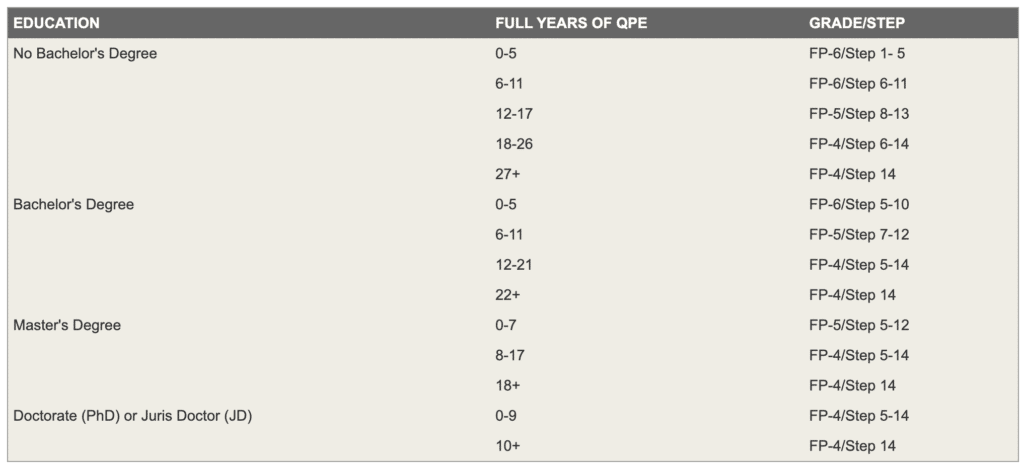
The level of education achieved is straightforward. However, there are some nuances you will want to review in the above link.
But how is QPE determined? You can find a lengthy definition of QPE on the Bureau of Human Resources website, and I recommend checking it out. But here is the crux of the definition:
…refers to work in a field that generally requires a bachelor’s degree or higher. Experience in clerical, wage-grade positions, or other roles that do not require a bachelor’s degree will not be considered. Qualifying professional experience involves the application of specialized knowledge, acquired through a bachelor’s degree or higher in a relevant field conferred from an accredited academic institution. Recognized fields include, but are not limited to, journalism, social sciences, business management, project management, marketing, economics, political science, law, engineering, computer science, healthcare, teaching, or natural sciences. Volunteer work may be credited if it meets the definition of qualifying professional experience.
Each year of QPE counts as one additional step.
Your QPE rounds down if you do not have a full year of professional experience. For example, 2.5 years of experience is considered to be 2 years of QPE.
However, if the addition of QPE would put you at a step higher than 14, your step is 14, and you do not move to the next grade.
To best illustrate salary going forward in this guide, we will need the help of Sarah, the newest member of the FSO family.
Sarah is in her early thirties, works as a consultant earning $69,000, is single, has no children, holds a Master’s degree, and has 2 years of QPE.
Let’s determine her grade and step!
First, education. With a Master’s Degree, Sarah will either enter as a grade 4 or 5.
Second, QPE. With two years of QPE, Sarah falls in the 0-7 ‘full years of QPE’ row and column.
Putting it all together, Sarah attains the grade FP-5. We add her two years of QPE to the minimum step in the range (i.e., 5) to determine her step.
Sarah’s grade and step are thus FP-5/Step-7.
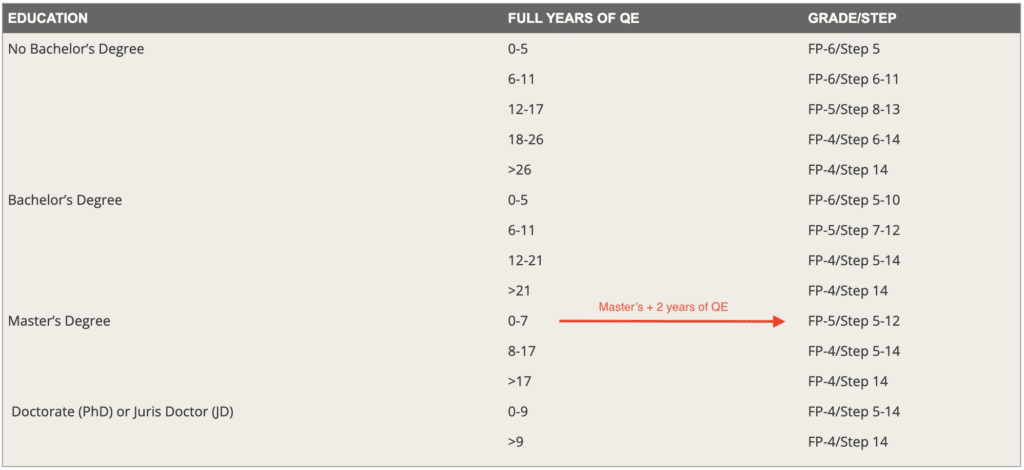
Take a moment and look at the image above to get an idea of your grade/step if you enter the Foreign Service today.
Takeaway 3: You can determine your entry-level FSO grades and steps by combining the education achieved and the years of QPE attained.
Attempt to match salary
Once you calculate your grade and step, the Bureau of Human Resources will attempt to match your current salary.
Once a candidate’s grade and step are determined based on education and qualifying experience, IPO will review their current salary to determine if it exceeds the projected salary in the Foreign Service Overseas Salary Table. If the current salary is higher, the candidate’s starting salary will be adjusted to the closest step at or above their current salary within the assigned grade. If the current salary exceeds the highest step available for the assigned grade, the candidate will be placed at step 14 of that grade.
So what does this mean?
If your initial grade and step result in a loss of salary, you will advance within a grade until you reach a step that corresponds slightly higher than your current salary.
However, if your current salary is higher than the step 14 salary within the grade you were assigned, you will be set to step 14. One does not advance to the next highest grade.
If you think about it, that’s cool for the State Department to make this adjustment.
To help explain this further, let’s look at Sarah again, who currently earns $69,000, and determine how this may affect her salary.
For further illustration, below is the 2026 Foreign Service Salary Table Base Schedule, effective January 11, 2026.
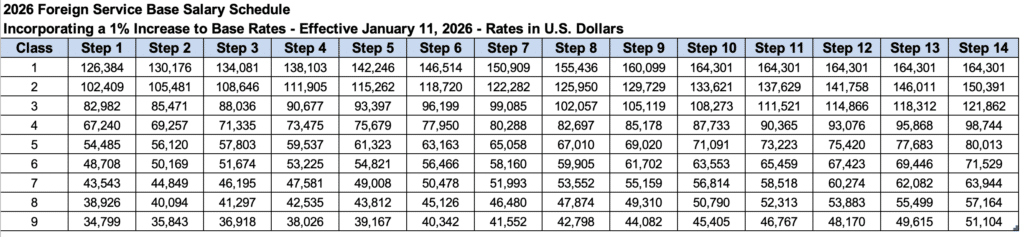
From the steps we completed above, we know Sarah’s grade and step are FP-5/Step-7.
Knowing this, we can determine her base salary as $65,058. You can see this in the table below (in the red-highlighted box).
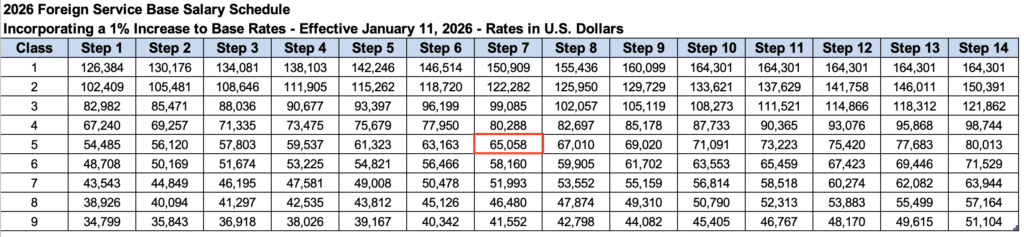
But wait! Sarah’s current salary is $69,000. Working as an FSO would mean a loss of almost $4,000… right?
Wrong.
Fortunately, DOS matches her salary to the next highest step. In this example, Sarah’s salary step will rise to step 12 within FP-5.
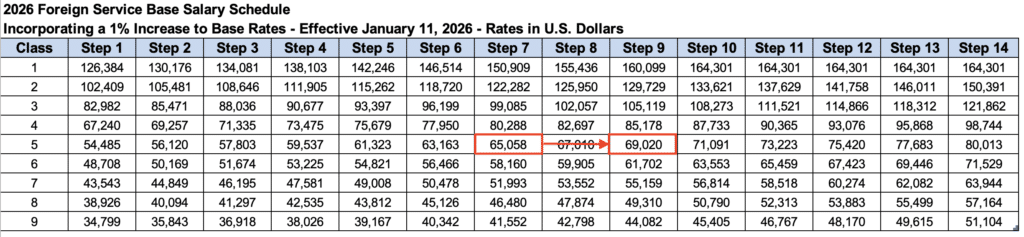
So we’ve figured it out! Sarah’s salary is $69,020.
Nope, wrong once more.
Let’s return to the description above.
The candidate’s salary rate is then set at that grade and step as provided in the Foreign Service “Overseas Comparability Pay” Salary Schedule.
Let’s look at the “Overseas Comparability Pay” table and add a red box around the appropriate step and grade.
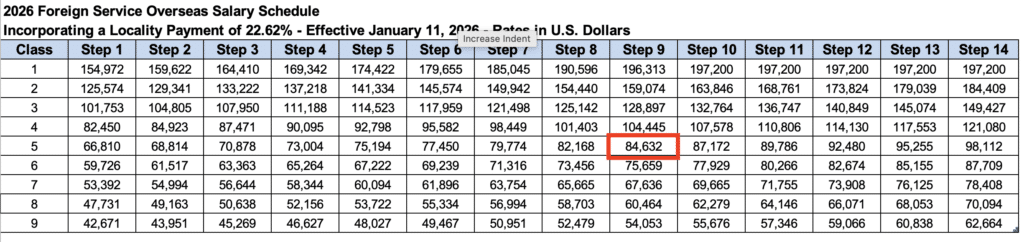
Considering “Overseas Comparability Pay,” at FP-5/Step-9, Sarah’s salary is $84,632.
And there we have it!
Sarah’s new entry-level grade and step are FP-5/Step-9, with a salary of $84,632.
Go ahead and determine how salary matching affects you!
Takeaway 4: The Bureau of Human Resources will attempt to match your current salary by increasing your step level. The maximum is step 14 within your assigned grade.
PART 3: Promotions
Once in the system, you may wonder about the general process of moving between grades and steps, a.k.a. being promoted.
First, you are considered for promotion once a year. Your promotion depends on the Department’s needs, your performance, and your potential.
There is an exception: if you enter the Foreign Service as an FP-4/Step-14, you are only eligible for promotion (grade or step) once you are tenured (the first tenure review is after 36 months). You may receive a salary increase within those three years.
Second, for promotion between grades, it is not a requirement to be at step 14 to advance to the next grade.
Third, when you are promoted between grades, you are promoted to a different step level than your current one. For example, all other things equal, if Sarah receives a promotion, she is not promoted to FP-4/Step-9.
Instead, when you go up a grade, your step level is found by finding the step that matches your current base salary the closest and then going up two steps or 6%, whichever is greater (3 FAH-1 H-2325 Effect of Promotion on Basic Salary).
For Sarah, in the next grade, the step that closely matches her current base Grade/Step is FP-4/Step-5 (base salary at FP-5/Step-12 is $70,128; base salary at FP-4/Step-5 is $74,656).
The following table helps illustrate this movement:
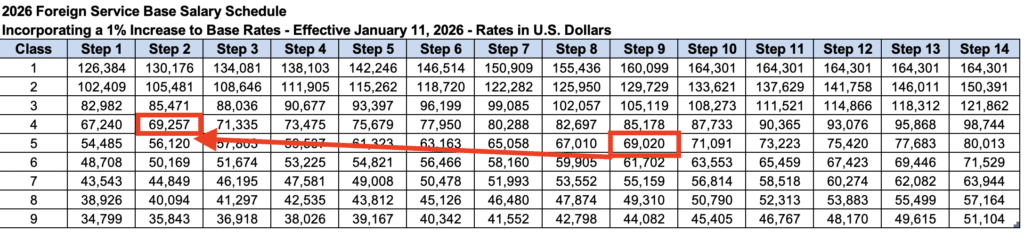
We must then compare our two options and choose the greater of the two: (1) go up two steps or (2) 6%.
A 6% raise is $73,161.
A two-Step increase (FP-4/Step 4) is $73,475.
The two-Step increase is greater, promoting Sarah to FP-4/Step 4.
Takeaway 5: You are considered for promotion once a year.
Takeaway 6: If promoted to a new grade, the step you are assigned will be based on your former step salary, not the step number.
In the following three chapters, we will discuss the three most common allowances affecting all FSOs.
Foreign Service Officer Danger Pay Allowance
Unfortunately, not all assignments are safe, and some carry extra danger.
I bet if you think hard, you’ll figure out a few of them.
The State Department thanks you for taking on these dangerous assignments by bumping your pay.
Thanks, Uncle Sam!
PART 1: What is danger pay allowance?
You may be familiar with the Danger pay allowance, which is the monetary supplement most of you have heard of.
Afghanistan, Iraq, Yemen… get sent to one of these countries, and the question of whether or not you will be paid more for it will cross your mind.
And the answer is YES.
The fact that which posts are dangerous, not just difficult, is an important distinction. Additionally, the State Department defines danger pay, noting that this designation can change depending on the current state of affairs in that country.
For the post danger pay allowance designation, it must be:
Danger Pay is additional compensation above basic compensation for service at designated Danger Pay posts where civil insurrection, terrorism, or war conditions threaten physical harm or imminent danger to all U.S. Government civilian employees.
Further, to earn danger pay, you must first spend 4 cumulative hours at that post. After the four-hour mark, you will receive a danger pay allowance for the full day.
This means if you fly into Yemen from Egypt, do three hours of work, and then are wheels up before the four-hour mark, you do not receive danger pay.
The designation of danger pay and the amount of the allowance are reviewed annually.
For more information, visit the FAQ concerning danger pay.
PART 2: Danger pay allowance rates
Danger pay allowance is a taxable supplement designated at 15%, 25%, or 35% and based on overseas comparability pay.
As such, the more dangerous a post, the higher the allowance you receive.
Instead of just listing the countries and their allowances (boring), you will find an interactive map below to play with.
Color-coded, you can visualize the different danger pay posts (the darker the shade of red, the higher the danger pay allocation) and see which countries share the same danger pay allowance.
Additionally, if you hover over Yemen, Iraq will change to light blue to indicate that it shares the same danger pay allowance (as will the others that share the same allocation).
Going back to our recent FSO employee, if Sarah is stationed in Haiti, her danger pay allowance is 35%. With a salary of $84,632, a 35% allowance comes to $29,621.
You can view the Department of State Danger Pay Allowance Table for a complete listing.
Takeaway 7: If given, the danger pay allowance is set at 15%, 25%, or 35% of overseas comparability pay and is initiated when most employees stationed in a post are under conditions that threaten physical harm due to political upheaval.
A disclaimer regarding the maps
The allowances shown on this page’s maps are where the U.S. Embassy or the predominant U.S. diplomatic mission is located. For example, Bamako, Mali, has a danger pay allowance of 25%, as indicated on the map above. However, the danger pay may differ if you are posted elsewhere in Mali. This applies to all allowance discussions on the maps that follow.
Foreign Service Officer Hardship Post Allowance
Citizens in the U.S. are fortunate to live in a country with a higher standard of living than many others, and their people have grown accustomed to it.
A hardship allowance designation is much more common. However, unlike danger pay, hardship doesn’t mean life-threatening.
For example, is the country’s pollution too toxic? If so, here is a bonus for you.
PART 1: What is hardship post allowance?
The Office of Allowances provides post hardship differential:
For service at places in foreign areas where conditions of environment differ substantially from conditions of environment in the United States.
A review of hardship post differential occurs at least biannually.
PART 2: Hardship post allowance rates
As danger pay, a hardship post is a taxable allowance that ranges from 0 to 35% of overseas comparability pay.
If Sarah were stationed in China, her hardship post allowance would be 20%. With a salary of $84,632, a 20% allowance comes to $16,926.
Take a look at the map and let me know your thoughts on the hardship allowance.
You can view the Department of State Hardship Post Allowance Table if you want a complete list.
Takeaway 8: Hardship post allowance ranges from 0-35% of overseas comparability pay and is broadly based on unhealthy living conditions, measured at least biennially.
Foreign Service Officer Cost-of-Living Allowance (COLA)
Compared to the rest of the world, the U.S. is fortunate to have inexpensive goods.
Some countries are expensive to live in, especially given their geographic location (e.g., islands) or currency exchange rates.
Gas costs how much?! Oh my, here’s some extra $$$.
PART 1: What is a Cost-of-Living Allowance?
A cost-of-living allowance (COLA) differs from the previous two allowances by not being a percentage of your overseas comparability pay, and it is also not taxable.
Instead, COLA is a percentage of spendable income, which is the portion of salary used to purchase the goods and services in the cost-of-living “market basket.”
The market basket is an index of categories that shows the percentage weights of goods and services in foreign posts relative to their prices in Washington, D.C.
COLA is granted to an FSO officially stationed at an overseas post where the cost of living, excluding housing and education, is “substantially higher than in Washington, D.C.” (at least 3% more).
More information on the rules and stipulations concerning COLA is available online.
The “market basket” includes the following categories and their corresponding percentages:
- Food at and Away from Home (32%);
- Alcohol/Tobacco (3%);
- Clothing (7%);
- Personal Care (3%);
- Household Furnishings (8%);
- Medical (3%);
- Recreation (15%);
- Public and Private Transportation (14%); and
- Household Operations (15%).
How is the post allowance determined?
Washington, D.C. is the base of 100. When the overall cost of goods and services at the foreign location are at least 2.5% above those in Washington, D.C. (index 102.5 or higher) then a post allowance is established. Ranges for the post allowance are at DSSR 228.2. The expenditure pattern is based on the average Washington, D.C. family living in the foreign area. This family consists of three to four persons with an employee’s salary of a GS-12, Step 6 (or FS-equivalent).
Most posts have a COLA.
Fun fact: Central African Republic, Eritrea, and Switzerland have the highest COLA at 130% of spendable income!
You can view the Department of State COLA Table if you want complete listings.
PART 2: Spendable income
Now that you know how percentages are derived and how COLA compares internationally, let’s look at how your spendable income is determined.
Your salary and family’s size determine your annual spendable income.
Let’s revisit Sarah once more. Sarah’s salary is $84,632. She is single with no children.
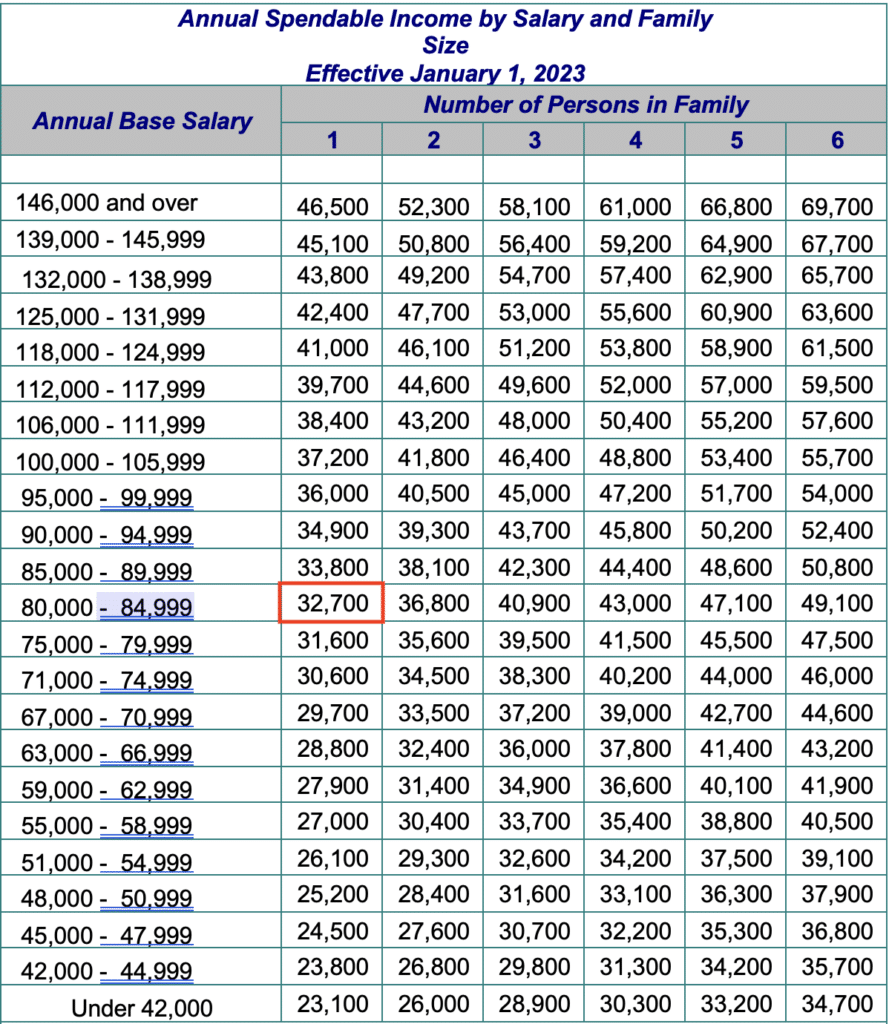
Given the information we have on Sarah, her annual spendable income is $32,700.
PART 3: COLA Example
If Sarah were posted in Thailand, her COLA would be 15% of her spendable income ($32,700), which comes to $4,905. This income is added to her pay and is not taxable.
Takeaway 9: COLA is a percentage of your spendable income and is not taxable.
Takeaway 10: As your base pay increases and (possibly) the number of persons in your family, so will your annual spendable income.
Hardship pay, danger pay, and COLA - putting it all together
Just like a puzzle, we now have a better understanding of what goes into the FSO salary by putting together a little bit of information.
Let’s see the image we create by combining everything we have learned into one final map.
We’ve now discussed the three significant allowances that affect a Foreign Service Officer’s salary: Hardship pay, danger pay, and Cost-of-living.
Quite a bit of information!
From reading the sections above, you know how each allowance is allocated and how the countries compare.
This information is already interesting, but viewing the entire picture makes for an exciting analysis.
The map below compares the diplomatic posts that take the information above and adds it up.
One last time, to our new Foreign Service Officer Sarah:
Sarah has just completed the first part of her training in Washington, D.C., and on ‘Flag Day,’ she finds out she is moving to Nairobi, Kenya.
Exciting!
Let’s determine her salary (at minimum) from the information we have learned above.
| Base Salary | Amount | Explanation |
| Base Salary: | $69,020 | FP-5/Step-9 |
| Overseas Pay: | $84,632 | Overseas Comparability Pay |
| Allowances | Amount | Explanation |
| Danger Pay: | $0 | No danger pay |
| Hardship Pay: | $16,926 | 20% of overseas pay |
| COLA: | $3,270 | 10% of spendable income: $32,700 |
| Total | $104,828 | Overseas Pay + allowances |
The combined map below will help to visualize all this information. We use Sarah’s details to map the information.
When you scroll over a country, you will see two outputs. The first would be Sarah’s annual salary if stationed there. The second is the percentage increase in salary compared to her overseas comparability pay.
I find this dynamic map very interesting and hope you do too. There is just so much information! For instance, these four countries have the same salary and are in different parts of the world: Cambodia, Guyana, Kosovo, and Madagascar.
Also, just in case you are wondering, the six posts with the highest percentage increases are:
| Rank | Country | Salary | % Inc. |
|---|---|---|---|
| 1 | Central African Republic | $182,485 | 115.62% |
| 2 | Dem. Republic of the Congo | $160,880 | 90.09% |
| 3 | Haiti | $156,202 | 84.57% |
| 4 | South Sudan | $154,493 | 82.55% |
| 5 | Eritrea | $152,864 | 80.62% |
The complete list
There is a lot of information found in salary comparisons. For a complete review and an opportunity to calculate your salary, look at this spreadsheet:
Conclusion
Well, that does it. Feel free to bookmark this page so you can reference it later.
I put this resource together because I could not find one location discussing all the information above. Instead, many sources described only separate parts. Now, a comprehensive guide exists.
I am not an employee of the State Department. To my knowledge, the information above is accurate as of the posting date. I am happy to support general questions, but please communicate with the Bureau of Human Resources or the Office of Allowances for specific inquiries.
Having read this guide, you should now understand how to determine your base salary, overseas comparability pay, and the three primary allowances that affect all FSO salaries.
However, there are additional allowances that will alter your salary between posts.
Three examples not discussed in this guide are:
- Education allowance (if you have children, then their education is covered overseas)
- Difficult-to-staff incentive differential
- Quarters allowance (free housing overseas or a generous stipend)
If you are not in the Foreign Service but interested in joining, I hope this information has been helpful (learn more about becoming a Foreign Service Officer)! I look forward to your insights if you are in the Foreign Service.